Challenge seeks
online tool to help socially isolated Americans connect and engage
Today, the Administration
for Community Living (ACL) and the Office of
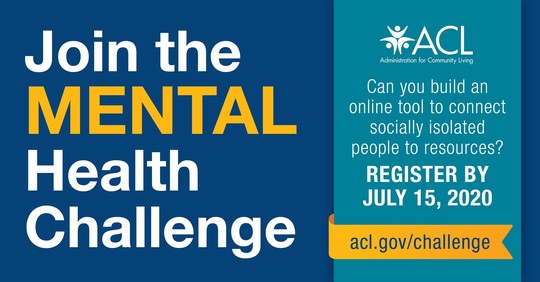
the Assistant Secretary for Health launched the MENTAL Health
Challenge to combat the social isolation and loneliness that older
adults, people with disabilities, and veterans often experience. A total
of $750,000 in prizes will be awarded for development of an easy-to-use
online system that offers recommendations for programs, activities and
resources that can help users connect to others and engage in the community,
based on their individual needs, interests, and abilities. The winning
system will be announced and demonstrated in January 2021 at CES.
And it ultimately will become the centerpiece of a national public
awareness campaign.
Social disconnection has enormous health consequences.
Social isolation has been found to be as harmful to a person’s health as
smoking 15 cigarettes a day, and people who are socially isolated or
lonely face higher risk of hospitalization; depression, anxiety and suicide;
heart failure and stroke; dementia; and even premature death. Not
surprisingly, a recent analysis found that Medicare spends an additional
$6.7 billion every year on enrollees who are socially isolated.
“We need a multipronged public health approach to change the
way we address social isolation, especially among our most at-risk
populations,” said U.S. Surgeon General, VADM Jerome M. Adams, M.D.,
M.P.H. “This approach must include the development of innovative
solutions to combat the harmful physical and mental health effects of
social isolation and the role technology has in promoting better
connections for all.”
For a variety of reasons, older adults, people with
disabilities, and veterans are more likely to be socially isolated and to
report feeling lonely. Nearly a quarter of Americans who are 65 or older
have few social relationships or infrequent social contact with others,
and more than 40 percent of people 60 and older report feeling lonely. In
one small study, people with disabilities were more than three times more
likely to report feelings of loneliness than people without disabilities.
Veterans report higher rates of loneliness than civilians, particularly
if they have functional limitations or have experienced traumatic events,
and loneliness has been cited as the top risk factor for suicidal
ideation in veterans.
The number of older adults is projected to almost double by
the year 2060, the population of people with disabilities also is
growing, and 22 veterans die by suicide every day. There is a clear and
critical need to help all three connect with others and engage in their
communities. This is particularly true when normal social interaction is
limited due to a crisis like the COVID-19 pandemic.
“For many older adults and people with disabilities,
increased social isolation and loneliness is one unfortunate consequence
of physical distancing to slow the spread of COVID-19,” said Lance
Robertson, ACL Administrator and HHS Assistant Secretary for Aging.
“We need to have a wider range of tools and resources to help people
remain connected and engaged, and an easy-to-use way for people to find
and access them.”
“Staying connected to family, friends, and colleagues is
important, especially during the pandemic,” said FCC Chairman Ajit Pai.
“The FCC has a long history of helping ensure that those at risk for
isolation, like older Americans and people with disabilities, can access
the communications technologies that can keep them connected, healthy,
and safe. We look forward to joining HHS and others in this important
effort to enable technology to help vulnerable Americans.”
“Technology can provide unique solutions to combat social
isolation. The Trump Administration is committed to leveraging the
Nation’s entrepreneurial spirit to address the pandemic, and we know
America’s innovators will rise to this challenge,” said U.S. Chief
Technology Officer Michael Kratsios.
About the partners for MENTAL Health Innovation Challenge:
- The
Administration
for Community Living (ACL) was created around the
fundamental principle that older adults and people of all ages with
disabilities should be able to live where they choose, with the
people they choose, and with the ability to participate fully in
their communities. By funding services and supports provided by
networks of community-based organizations, and with investments in
research, education, and innovation, ACL helps make this principle a
reality for millions of Americans.
- The Office of the Assistant
Secretary for Health oversees the Department’s key
public health offices and programs, a number of Presidential and
Secretarial advisory committees, 10 regional health offices across
the nation, the Office of the Surgeon General, and the U.S. Public
Health Service Commissioned Corps.
- In
1976, Congress established the White House Office of Science and Technology
Policy to provide the President and others within
the Executive Office of the President with advice on the scientific,
engineering, and technological aspects of the economy, national
security, homeland security, health, foreign relations, the
environment, and the technological recovery and use of resources,
among other topics.
- The
mission of the U.S.
Department of Veterans Affairs (VA) is to fulfill
President Lincoln's promise “To care for him who shall have borne
the battle, and for his widow, and his orphan” by serving and
honoring the men and women who are America’s veterans. Within the
VA, the Veterans
Health Administration is the largest integrated health
care network in the United States, with 1,255 health care facilities
serving nine million enrolled veterans each year.
- The Federal Communications
Commission regulates interstate and international
communications by radio, television, wire, satellite, and cable in
all 50 states, the District of Columbia and U.S. territories. An
independent U.S. government agency overseen by Congress, the
Commission is the federal agency responsible for implementing and
enforcing America’s communications law and regulations.

|



No comments:
Post a Comment