|
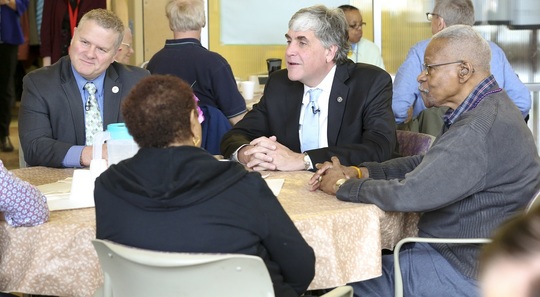
HHS Deputy Secretary Eric Hargan and ACL Administrator Lance
Robertson meet with older adults at the Walter Reed Center. Click the image
to watch a video of the visit.
HHS Deputy Secretary Eric Hargan and ACL Administrator Lance
Robertson arrived at the Walter Reed Senior and Community Center in Arlington,
VA just before lunch time, and the center was full of activity.
"Let's do this," a man said as he prepared to take a
shot at the pool table. In the gym, the 55-and-over basketball game was
gearing up. Down the hall, the intermediate line dancing class practiced a
dance choreographed to Alec Benjamin's "Let Me Down Slowly.” Next
door, Blanche Kirchner led a painting class, as she has for 40 years.
At 97 years old, Kirchner is Arlington County’s longest-serving employee.
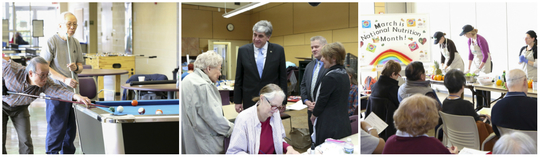
Left: Two older adults play pool at the Walter Reed Center.
Center: Deputy Secretary Eric Hargan and ACL Administrator Lance Robertson
meet Blanche Kirchner, 97, who has been teaching art at the center for 40
years. Right: Volunteers from the Virginia Cooperative Extension host an
"Eat the Rainbow" healthy cooking demonstration.
Hargan and Robertson were visiting the center to help kick off
National Nutrition Month®. The center is one of thousands of senior
centers, churches, schools, and other community spaces serving meals through
the congregate meals program established by the Older Americans Act.
Together, these programs serve more than 75 million meals a year to over
1.5 million Americans.
As many as half of older Americans are malnourished or at risk
of being malnourished, and nearly 5 million Americans lack consistent
access to enough food for a healthy life. With food insecurity and
malnutrition associated with a variety of negative health outcomes,
including more frequent and longer hospitalizations, the congregate meals
program plays an important role in helping older adults remain healthy and
independent.
In fact, 58% of participants say that the meal they receive
through the program provides at least half of their total food for the day.
A 2017
evaluation found that participants in the program have
better diets and are less likely to face food insecurity compared to
similarly-situated older adults not participating in the program.
While nutrition is the most obvious benefit of the meals
programs, the older adults at the Walter Reed Center would be the first to
tell you they are getting much more than lunch.
"When I'm here, I talk with everybody," said Lem Lem
Ekoubegize. "I love it. I don't want to miss it."
She is not the only one. 80% of congregate meal participants surveyed
by the National Association of Nutrition and Aging Services Programs said
they had more friends after joining the program.
"A big problem that we see is that older Americans often
become socially isolated from each other," Hargan said while visiting
the Walter Reed Center. "So a center like this, where people come for
the food but they stay for the company, is really important."
Like malnutrition, loneliness and social isolation can have
grave consequences for older adults' health. For example, social isolation
is associated with higher blood pressure and earlier onset of dementia.
Older adults who are socially isolated also face a greater risk of being
targeted for abuse, neglect, or exploitation.
The meal programs also often serve as a gateway to other
important services and activities. More than two-thirds of congregate meal
providers also offer other activities for older adults, with more than half
offering at least 25 hours of activities a week. Seniors who drop by for
meals often stay for these activities and have the opportunity to
learn about services and programs they otherwise may not know about, such
as heating assistance or prescription drug assistance programs.
The combination of nutrition, socialization, and connection to
other resources and activities may help explain why participating in a
congregate meal program leads to better health and a greater
likelihood of staying in the community.
The 2017 evaluation of the program found that older adults
participating in congregate meal programs are less likely to be admitted to
a hospital or nursing home. The gap was particularly stark among lower
income older adults. For example, 4.5% of lower income older adults
participating in congregate meal programs had been admitted to a hospital
after an ER visit in the nine month before they were interviewed, compared
to nearly 16% of those not participating in the program.
Ekoubegize participates in Tai Chi and monthly health and
wellness sessions led by doctors, nurses, and nutritionists. Recently, her
primary care physician told her she was in good health and asked what she
was doing to stay healthy.
"I'm listening to the (people at the Walter Reed Center)
who come for my health," she recalled telling her doctor.
"Whatever they tell me, I do it."
These health improvements can result in a better quality of
life for seniors. They also save money for programs such as Medicare and
Medicaid.
"(Seniors) want to be able to be in their homes but they
also want the opportunity to be able to socialize, to meet other people, to
do these activities, and also to have a meal," Hargan says. "It’s
a great thing, and it does help with our stewardship of taxpayer dollars as
well … It's really a win-win."
"We know that the lonely and sedentary lifestyle is
harmful," said Cheng Ping Feng, who participates in the Walter Reed
Center's congregate meals program. She says the meals and other activities
at the center allow older adults "to choose the active way."
|



No comments:
Post a Comment