Dan Goldbeck, Dan Bosch March
11, 2019
Rulemakings relating to various aspects of
health care policy were the main highlights of last week. A pair of proposed
rules provided the bulk of new costs. On the final rule side, however, there
was a modest net reduction in regulatory burdens. Between both proposed and
final rules last week, agencies published $4.1 billion in total net costs, as
well as 3.5 million hours of new paperwork.
REGULATORY TOPLINES
- New Proposed Rules: 50
- New Final Rules: 68
- 2019 Total Pages: 8,564
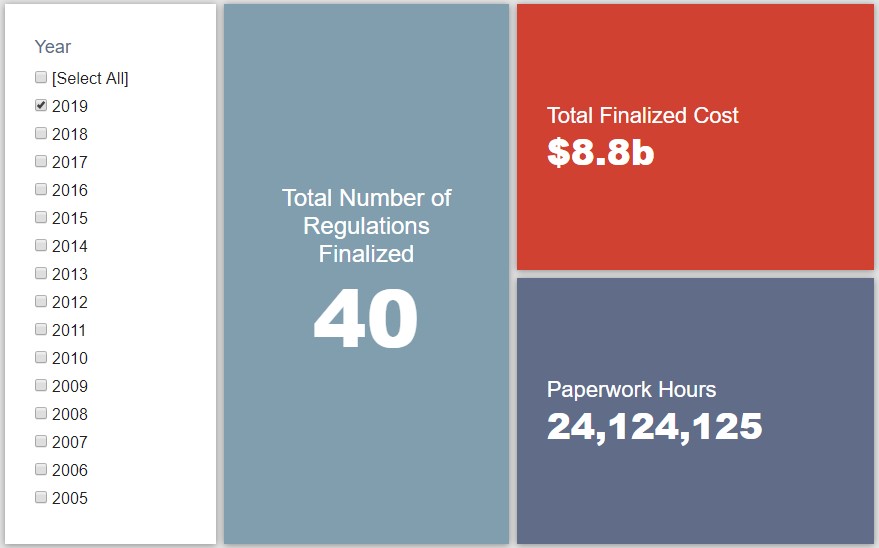
- 2019 Final Rule Costs: $8.8 Billion
- 2019
Proposed Rule Costs: $7.7 Billion
TRACKING THE REGULATORY BUDGET
Two proposed rules out of the Department of
Health and Human Services brought sizable cost figures. The most
significant proposal seeks
to implement various portions of the 21st Century Cures Act,
and it brings $3.7 billion in total costs over 10 years. The second proposal also
seeks to update interoperability issues under the Act, but it focuses primarily
on their implications for Medicare and Medicaid. It brings $500 million in new
paperwork compliance costs. Since these are both still proposed rules, these
burdens do not yet count toward the fiscal year (FY) 2019 regulatory budget
established under Executive Order (EO) 13,771.
The most notable rulemaking that did apply to
the FY 2019’s regulatory budget was a deregulatory action out of the Department
of Transportation (DOT). The rule revises certain requirements “to reduce the
training time and costs incurred by Class B commercial driver’s license (CDL)
holders upgrading to a Class A CDL.” DOT estimates that this could produce
total savings of up to $278 million. The agency is now ahead of its FY 2019
regulatory savings goal by roughly $300 million.
So far in FY 2019 (which began on October 1,
2018), there have been 33 deregulatory actions (per the rubric created by EO
13,771 and the administration’s subsequent guidance document) against 14 rules that
increase costs and fall under the EO’s reach. Combined, these actions yield
quantified net costs of roughly $10.1 billion. This total,
however, includes the caveat regarding the baseline in the Department of
Agriculture’s “National Bioengineered Food Disclosure Standard.” If
one considers that rule actually to be deregulatory, the administration-wide
net total is approximately $3.4 billion in net costs. The administration’s
cumulative savings goal for FY 2019 is approximately $18 billion.
THIS WEEK’S REGULATORY PICTURE
One can describe “regulatory policy” in many
ways: mundane, opaque, monotonous, complex, legalistic. The list goes on. In
order to help provide a clearer and more straight-forward view into this world,
the American Action Forum will seek to provide a brief illustration of a
notable regulatory trend we have identified in a given week. This week: that
feeling when no one wants to speak at your regulatory comment hearing…

One of the hallmarks of the American rulemaking process is public participation. In addition to public comment periods offered by an agency when it proposes a rule, many times an agency will hold a public hearing to let anyone offer their input. Sometimes no one really cares about a proposed change enough to ask to speak, however, as the Internal Revenue Service (IRS) learned this week.
One of the hallmarks of the American rulemaking process is public participation. In addition to public comment periods offered by an agency when it proposes a rule, many times an agency will hold a public hearing to let anyone offer their input. Sometimes no one really cares about a proposed change enough to ask to speak, however, as the Internal Revenue Service (IRS) learned this week.
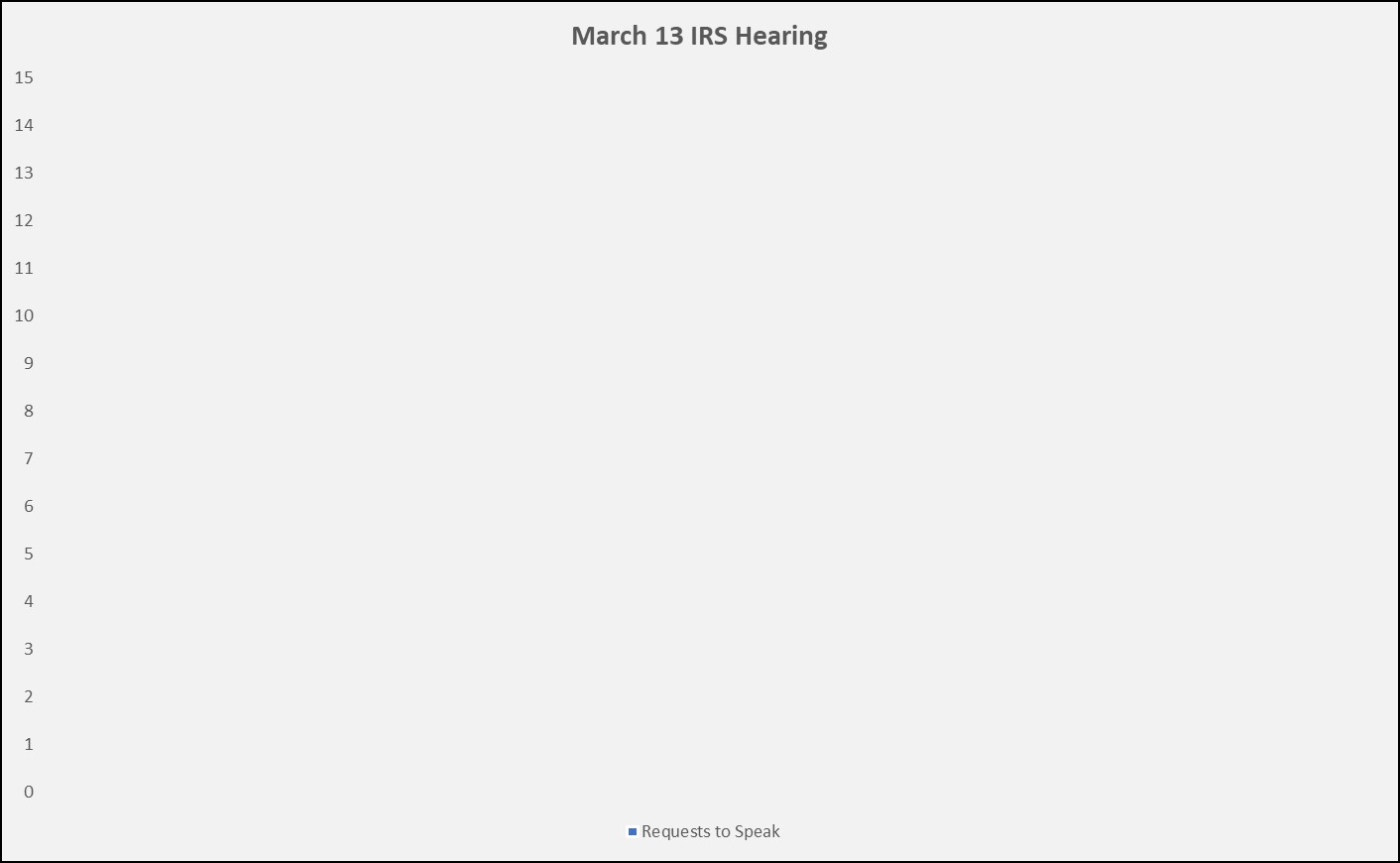
The chart above shows the number of requests
submitted to the IRS to speak at a scheduled March 13 hearing on “Estate and
Gift Taxes: Difference in the Basic Exclusion Amount,” a rule proposed in
November. This week, the IRS cancelled the meeting because “no one
has requested to speak.” The interest in the hearing seems reflective of the
public’s interest in the proposal in general. According to Regulations.gov, the
proposal received just 15 comments during the written period, which
closed on February 21. IRS also published notices announcing three other hearings this past week; one wonders what
level of interest they may draw.
TOTAL BURDENS
Since January 1, the federal government has
published $16.5 billion in net costs (with $8.8 billion in finalized costs) and
12.8 million hours of net paperwork burden increases (including roughly 24.1
million hours from final rules). Click
here for the latest Reg Rodeo findings.
https://www.americanactionforum.org/week-in-regulation/a-costly-health-care-week/#ixzz5hzONnWJ2
Follow @AAF on Twitter
Follow @AAF on Twitter

No comments:
Post a Comment