|
|
News Release |
|
|
Poll: Large Majorities Now Say They Wear Masks Regularly and Can
Continue Social Distancing for At Least Six Months if Needed, though
Republicans Remain Less Likely to Take Such Precautions At Least
Two-Thirds of the Public Favor Changes to Expand Coverage and Negotiate Drug
Prices Put Forward by President-Elect Biden As
winter sets in and COVID-19 cases and deaths reach records in most parts of
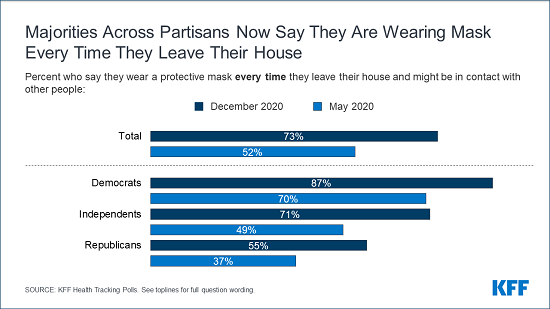
the country, more Americans say they wear masks every time they leave home
now (73%) than said so in May (52%), a new KFF Health Tracking Poll finds. A
small minority (11%) say they wear masks only some of the time or never. This
group is more likely to be white (70%), male (65%) and Republican (54%).
In
addition, 7 in 10 Americans (70%) say that they can continue to follow social
distancing guidelines to limit COVID-19’s spread for at least another six
months if necessary. Only small shares say they could follow such guidelines
less than another month (4%) or not at all (9%). There
are big partisan differences, with an overwhelming majority of Democrats
(87%) and just half of Republicans (50%) saying they can follow these
guidelines at least six months or until a vaccine is widely available. One in
five (20%) Republicans say they can’t follow the guidelines at all. The
willingness to wear masks and follow social distancing comes as two thirds
(68%) of the public worry that they or someone in their family will get sick
from coronavirus. This marks the highest level of concern recorded since KFF
began asking the question in February. As in the past, Democrats worry more
about this risk than Republicans. In
addition, half (51%) of adults say that worry or stress related to the
pandemic has had a negative impact of their mental health, similar to July
(53%). This includes a quarter (25%) who say it has had a major impact. Women
and young adults are more likely than men and older adults to report negative
mental health impacts. Fielded
just before the Food and Drug Administration approved any COVID-19 vaccines,
the poll finds half (51%) of the public say the “worst is yet to come” in the
pandemic, up from a low of 38% in September. Democrats are more than twice as
likely as Republicans to feel that way (72% v. 32%), with independents in the
middle (50%). “Republican
denialism mirroring President Trump, even in the face of a growing epidemic
in red states, has become a real public health challenge that the incoming
administration will need to take on,” KFF President and CEO Drew Altman said. The
poll also gauges the public’s views on several proposals to negotiate drug
prices and to expand access to affordable health coverage that
President-elect Biden promoted during the 2020 campaign. On
drug prices, nearly 9 in 10 (89%) favor allowing the federal government to
negotiate with drug companies to get a lower price for both Medicare and
private insurance. This includes large shares of Republicans (84%) and
independents (87%) as well as nearly all Democrats (97%). On
coverage expansions, large majorities support guaranteeing health insurance
coverage to lower-income people in states that have not expanded their
Medicaid program under the Affordable Care Act (76%); having a
government-administered “public option” heath plan available to all Americans
(71%); expanding government financial help for those who buy their own
insurance on the ACA marketplace (66%); and lowering the age when people
become eligible for Medicare from 65 to 60 (65%). There
is a wider partisan divide on the coverage proposals, with Democrats
generally most supportive and Republicans least supportive – though about
half of Republicans favor guaranteeing coverage to low-income people in
states that have not expanded Medicaid (54%) and lowering Medicare’s age of
eligibility (51%). A
large majority (80%) - including majorities across parties - also favor
protecting patients from surprise medical bills from out-of-network
providers, which is the subject of bi-partisan legislation being worked on in
Congress. As
part of his campaign, President-elect Biden focused on protecting and
building upon the Affordable Care Act to expand access to affordable health
coverage. Most of the public wants the incoming administration and Congress
either to build on the ACA (48%) or keep it as is (14%). Fewer want to scale
it back (9%) or repeal it entirely (20%). As
with the ACA overall, there are large partisan divisions, with most Democrats
and independents wanting to build on what the law does or keep it as is,
while most Republicans want to scale it back or repeal it entirely. Designed and analyzed by
public opinion researchers at KFF, the survey was conducted from Nov. 30-Dec.
8 among a nationally representative random digit dial telephone sample of
1,676 adults, including oversamples of adults who are Black (390) or Hispanic
(298). Interviews were conducted in English and Spanish by landline (391) and
cell phone (1,285). The margin of sampling error is plus or minus 3
percentage points for the full sample. For results based on subgroups, the
margin of sampling error may be higher Filling
the need for trusted information on national health issues, KFF (Kaiser Family Foundation)
is a nonprofit organization based in San Francisco, California. |
||
|
||
|
Connect with us: |
||
Saturday, December 19, 2020
Poll: Large Majorities Now Say They Wear Masks Regularly and Can Continue Social Distancing for At Least Six Months if Needed



Subscribe to:
Post Comments (Atom)
No comments:
Post a Comment