|
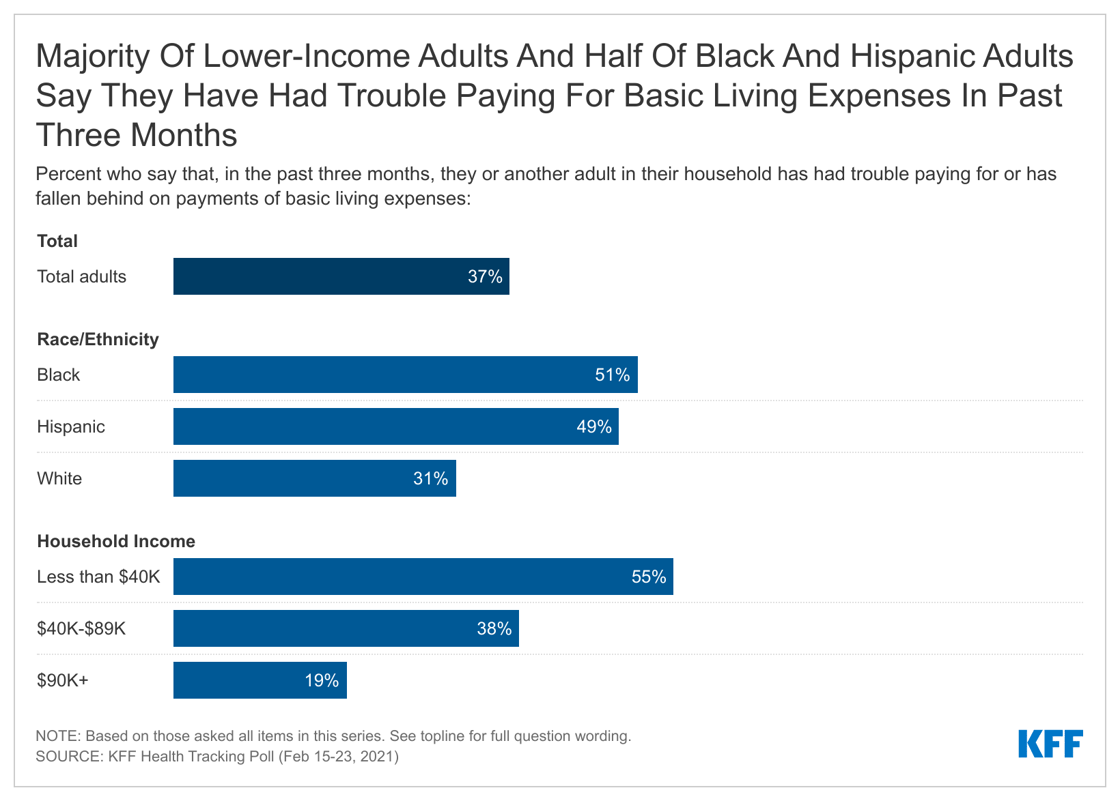
These financial
struggles come more than a year into the pandemic and reflect the
pandemic’s impact on people’s incomes. Overall, 44% of adults say someone
in their household lost a job or income since last February due to the
pandemic, including more than half of adults under age 50, and at least
half of Black and Hispanic households.
Families directly
affected by COVID-19 were especially hard hit, with 61% of households
with a COVID-19 diagnosis saying they lost a job or income due to the
pandemic, compared to 41% of households in which no one tested positive.
“The
COVID pandemic has hit many Americans hard financially, but the impact
can be doubly cruel when someone in the family gets COVID and suffers
economically at the same time,” KFF CEO Drew Altman said.
The
poll finds broad bipartisan agreement that Congress is not doing enough
to help people who lost a job or income due to the pandemic. About three
quarters (73%) of the public, including similar shares of Democrats
(74%), independents (73%) and Republicans (79%) say Congress isn’t doing
enough. Much smaller shares say Congress is doing about the right amount
(18%) or doing too much (6%).
Partisan
divisions emerge in their assessment of President Biden’s efforts to help
people who lost jobs or income due to the pandemic. Republicans
overwhelming say he is not doing enough (71%), while Democrats
overwhelming say he is doing the right amount (66%). Independents are
more divided, with nearly half (48%) saying not enough and more than a
third (37%) saying about the right amount.
Most
(62%) of the public approve of President Biden’s handling of the
pandemic, twice the share who disapprove (30%), though with big partisan
divisions. Nearly all Democrats (92%) and most independents (60%) approve
of President Biden's pandemic performance, while most Republicans (69%)
disapprove.
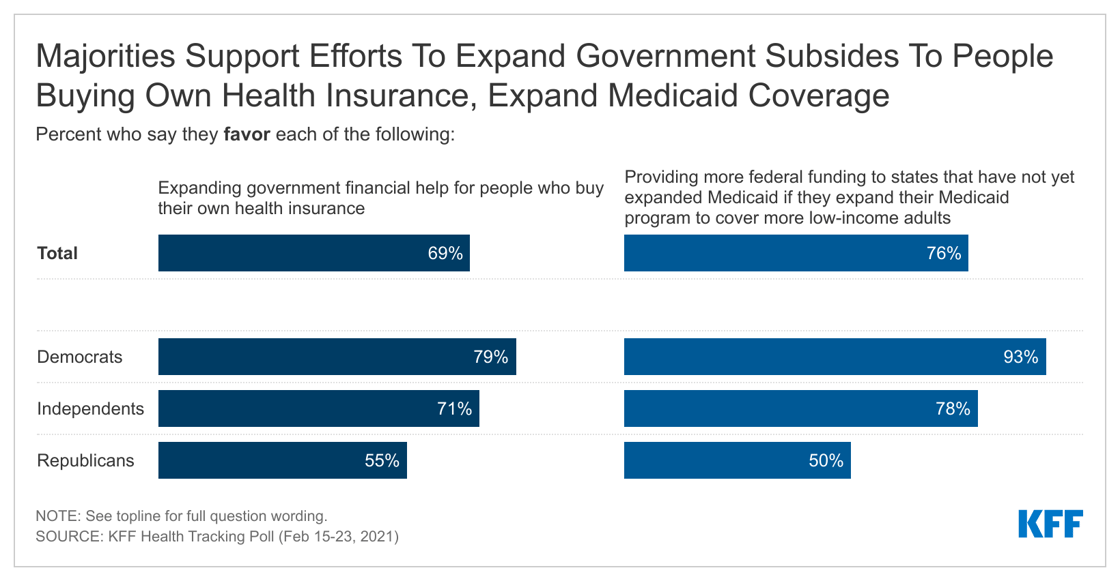
The
poll also finds broad support for two provisions in the House COVID-19
bill aimed at making health coverage more affordable by expanding tax
credits available to people who buy their own health insurance through
the Affordable Care Act’s marketplaces and by providing a financial
incentive for states who have not expanded their Medicaid programs to
cover more low-income adults to do so.
Expanding marketplace
subsidies is favored by 69% of the public, including a small majority of
Republicans (55%), while providing financial incentives for states to
expand Medicaid is favored by three quarters (76%) of the public,
including most Democrats (93%), more than three-fourths of independents
(78%), and half of Republicans.
|



No comments:
Post a Comment