|
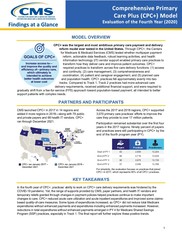
Comprehensive Primary Care
Plus (CPC+) Model
Fourth
Annual Report - Key Takeaways:
CPC+ was
the largest and most ambitious primary care payment and delivery reform
model ever tested in the United States. In the fourth year of CPC+,
practices’ ability to work on CPC+ care delivery requirements was
hindered by the COVID-19 pandemic. Yet, the range of supports provided
by CMS, payer partners, and health IT vendors and temporary reliefs
granted through changes in payment policies helped practices continue
to make important changes to care. CPC+ reduced acute care utilization
and acute inpatient expenditures and improved some claims-based
quality-of-care measures. Some types of expenditures increased, so CPC+
did not reduce total Medicare expenditures without enhanced payments
and expenditures including enhanced payments increased. However,
reductions in total expenditures without enhanced payments emerged in
Performance Year 4 for Medicare Shared Savings Program (SSP) practices,
especially in Track 1. The final report will further explore these
positive trends.
|
The Two
Page Overview:
The
Report (includes an Executive Summary):
Additional
Supporting Materials:
|
|
|
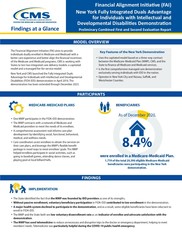
Financial Alignment
Initiative (FAI): New York Fully Integrated Duals Advantage for
Individuals with Intellectual and Developmental Disabilities
Demonstration
Preliminary
Combined First and Second Evaluation Report - Key Takeaways:
Stakeholders
perceived the care management model employed in this demonstration as
uniquely comprehensive, providing individuals with a level of control
over a wide range of detailed choices impacting their everyday lives.
Although the lack of participation by a major health care system used
by many eligible beneficiaries and opt-in only enrollment have
contributed to low enrollment levels, low voluntary disenrollment rates
suggest that enrollees and their advocates are satisfied with the
demonstration. The Fully Integrated Duals Advantage for Individuals
with Intellectual and Developmental Disabilities (FIDA-IDD)
demonstration increased Medicare expenditures for eligible
beneficiaries in the first 2 years of the demonstration but did not
have an impact on Medicaid expenditures. The demonstration has been
extended until December 31, 2023.
|
 The Two
Page Overview: The Two
Page Overview:
The
Report (includes an Executive Summary):
Additional
Supporting Materials:
|
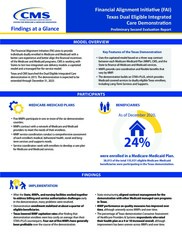
Financial Alignment
Initiative (FAI): Texas Dual Eligible Integrated Care Demonstration
Preliminary
Second Evaluation Report - Key Takeaways:
In the
first 3 demonstration years, the Texas Dual Eligible Integrated Care
demonstration had mixed results on service use and quality. The
demonstration had no impact on Medicare costs while generating Medicaid
savings cumulatively and in all 3 demonstration years. Measures of
beneficiary experience andMedicare-Medicaid Plan (MMP) performance have
improved over the course of the demonstration to date, although
improvement has been uneven across MMPs.
|
The Two
Page Overview:
The
Report (includes an Executive Summary):
Additional
Supporting Materials:
|
|
|
|




No comments:
Post a Comment