Medicaid’s New Option
to Extend Postpartum Coverage for 12 Months Could Prevent Hundreds of
Thousands of Enrollees from Losing Coverage in the Months After Delivery
The Option, Adopted by
33 States So Far, Is Receiving Renewed Attention As Some States Ban or
Curtail Abortion Access Following the Supreme Court’s Overturning of Roe
v. Wade
A new KFF
analysis finds that hundreds of thousands of people are
disenrolled from Medicaid each year after giving birth, which could be
prevented if all states were to take up a new option to extend Medicaid
postpartum coverage to 12 months.
The estimate – based on
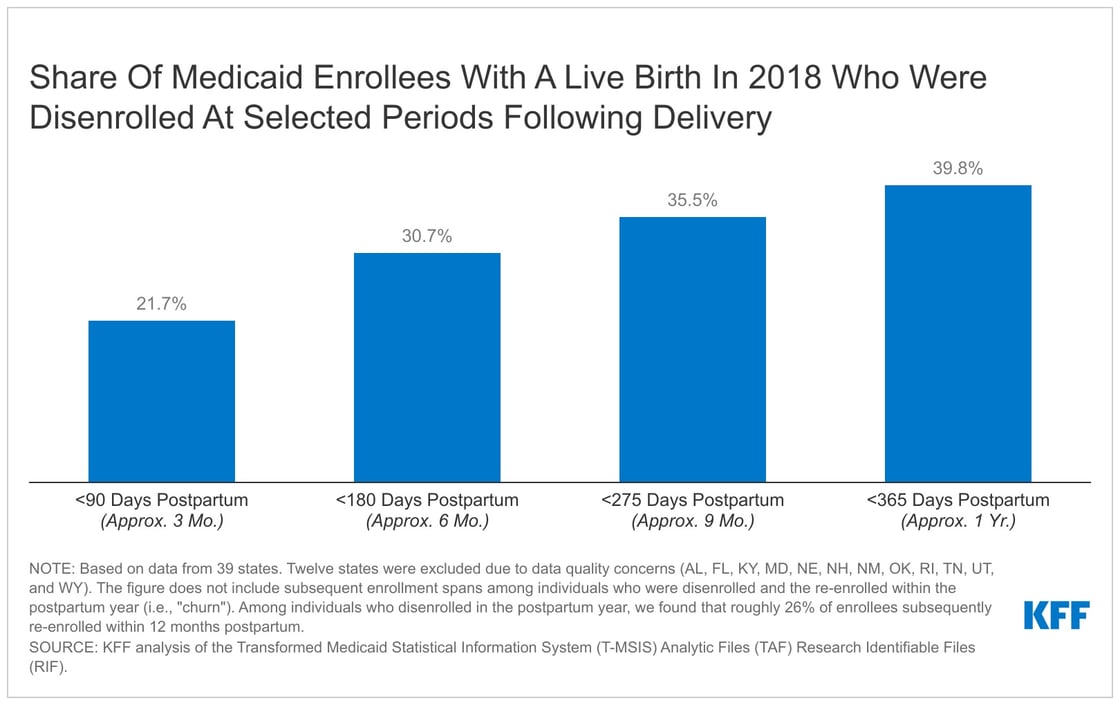
analysis of Medicaid claims data from 2018 – finds that 610,000
postpartum women were disenrolled within a year of giving birth, accounting
for about 40 percent of the 1.5 million Medicaid enrollees with live
births that year. A new federally funded state option to extend
postpartum care was created by a provision in the American Rescue Plan
Act of 2021. The new option took effect on April 1, 2022 and is available
to states for five years.
The option – adopted by
33 states so far and the focus of pending legislation in one other – is
receiving renewed attention amid rising maternal mortality rates and
following the Supreme Court’s decision to overturn Roe v. Wade. State
policy decisions about Medicaid postpartum coverage could be especially
impactful in states set to restrict abortion access, since the high
court’s ruling could affect the number of births in the U.S. covered by
Medicaid. Federal law only requires states to provide pregnancy-related
Medicaid coverage through 60 days following childbirth, after which some
enrollees may lose coverage if their income is too high to qualify for
Medicaid through some other eligibility pathway.
KFF researchers find
that among Medicaid enrollees with a live birth in 2018, 31 percent were
disenrolled within six months after delivery and 40 percent were
disenrolled within a year. Among those who were disenrolled within a
year, 1 in 4 (26%) subsequently re-enrolled in Medicaid during that same
12-month period following delivery. This phenomenon, known as “churn,”
can sometimes indicate that administrative barriers, rather than
ineligibility, were behind the coverage loss.
|
.png?width=1200&upscale=true&name=Just%20Released%20Header_1%20(1).png)


No comments:
Post a Comment