July 27, 2022 Gordon Gray
Executive Summary
·
According to the
Congressional Budget Office (CBO), debt held by the public will reach 185
percent of gross domestic product in 2052.
·
These updated
projections deviate from last year’s report largely as a result of higher
inflation over the first 10 years of CBO’s outlook but are largely unchanged in
their trajectory.
·
Before long, stabilizing
the debt will require an unprecedented fiscal consolidation.
The Long-Term Budget Outlook
The
Congressional Budget Office (CBO) released its updated Long-Term
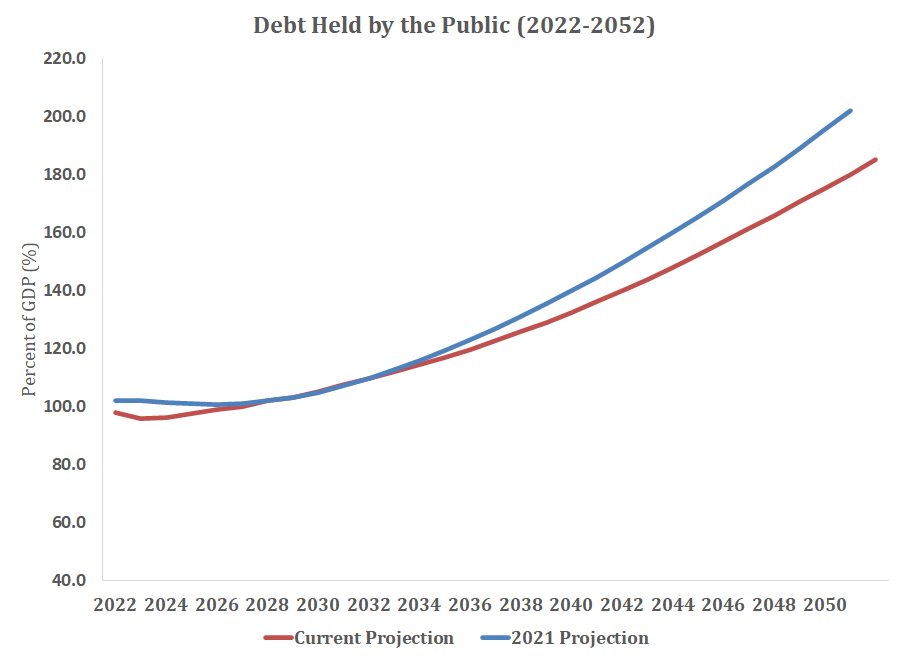
Budget Outlook and projected that U.S. debt held by the public
will nearly double as a share of the economy by 2052, rising from the current
level of 98 percent to 185 percent of gross domestic product (GDP).
Figure 1
The
debt as a share of the economy is presently 4 percentage points below what CBO
previously estimated, and the debt is expected to be lower over the next 6
years than was previously estimated. The debt outlook largely converges with
previous estimates until 2033, at which point the debt is expected to grow
incrementally slower than was previously estimated.
The
key element of these relatively small departures from last year’s estimates is
the effect of inflation on the federal budget. High price growth increases
nominal GDP, the denominator in the key budgetary metrics in CBO’s outlook.
Relatedly, inflation increases nominal revenue collection and nominal spending
as well, and both are elevated in the updated CBO’s baseline. The Federal
Reserve’s response to the inflationary environment has been to rapidly increase
interest rates, which CBO has necessarily incorporated in its projections. The
interaction of all these elements is necessarily complex and grows and recedes
in significance over the budget window.
Fundamentally,
the budgetary pressures that drive long-term debt growth are unchanged. The
United States is projected to spend, on average, 7.3 percent of GDP more than
it collects in taxes revenue over the next 30 years.
The
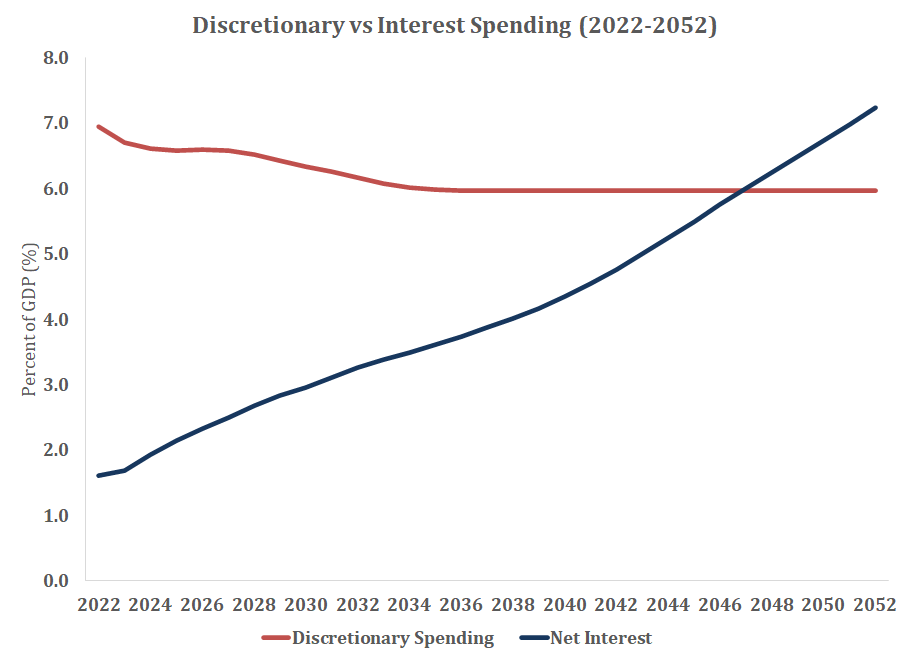
long-term outlook reaffirms a trend in the nation’s finances, as Figure 2
illustrates. Despite higher nominal GDP, debt service costs will crowd out
other federal expenditures, and in 2047 these costs will exceed all other
discretionary programs – such as defense, education, infrastructure – combined.
Figure 2
CBO
has also calculated the scale of tackling the budget challenge. To hold debt
held by the public as a share of GDP to 100 percent in 2052 would require
an annual reduction (relative to CBO projections) in the
deficit of 2.8 percent of GDP, about $800 billion in 2027, if begun in 2027.
CBO
also highlighted the effect that delay has on the scale of fiscal consolidation
needed to meet certain debt targets. For example, CBO estimated the fiscal
consolidation (non-interest spending cut or tax increase) necessary to
stabilize the debt at 80 percent of GDP by 2052. This more ambitious and
prudent target would require an additional 0.7 percentage points as a share of
GDP in annual fiscal consolidation than would stabilize the debt at present
levels. Delaying this fiscal consolidation until 2032 would add 0.8 percentage
points to the required fiscal consolidation, while waiting until 2032 would
make the challenge steeped by 1.4 percentage points of GDP. For context, the
magnitude of fiscal consolidation contemplated in any of these scenarios
significantly dwarfs all but one historical tax increase. Essentially, this
challenge would require deliberate fiscal consolidation on an unprecedented
scale.
Figure 3

https://www.americanactionforum.org/insight/lowlights-of-cbos-long-term-budget-outlook-2022/#ixzz7ap4pLxyZ
Follow @AAF on Twitter

No comments:
Post a Comment