 |
Just Released
|
||
|
More Than 3 Million People Age 65 or
Older Live with School-Age Children, and Could Be at Heightened Risk of
COVID-19 Infection if Children Bring the Virus Home from School
Older
People of Color are More Likely to Live with a School-Age Child Compared to
Their White Counterparts
About
3.3 million adults age 65 or older live in a household with school-age
children, a factor that state and local officials may want to take into
account when deciding when and how fully to re-open schools this fall, a new KFF analysis finds.
These
older adults, who represent roughly six percent of all seniors in the U.S.,
live with 4.1 million school age children, who comprise about seven percent
of all kids ages 5 to 18, the analysis finds. The data also show that older
people of color are significantly more likely to live with a school-age child
compared to their White counterparts.
All
of this matters because, according to the Centers for Disease Control and
Prevention, older people are among those at greater risk of becoming severely
ill if they get infected with the novel coronavirus, as are people of all
ages with serious medical conditions such as heart disease, diabetes, lung
disease, asthma and obesity. One concern state and local officials are
weighing is that children – who evidence so far indicates are at lower risk
of infection with COVID-19, are much less likely to die and generally present
with milder symptoms -- may become infected at school and carry the virus
back home, potentially infecting others in their household.
There
have been reports of community spread of the virus in recent months in
settings such as day cares, summer camps and college campuses. To the extent
that the virus may spread in schools, too, older adults of color bear a
disproportionate share of the risk of becoming infected by school children
bringing the virus home.
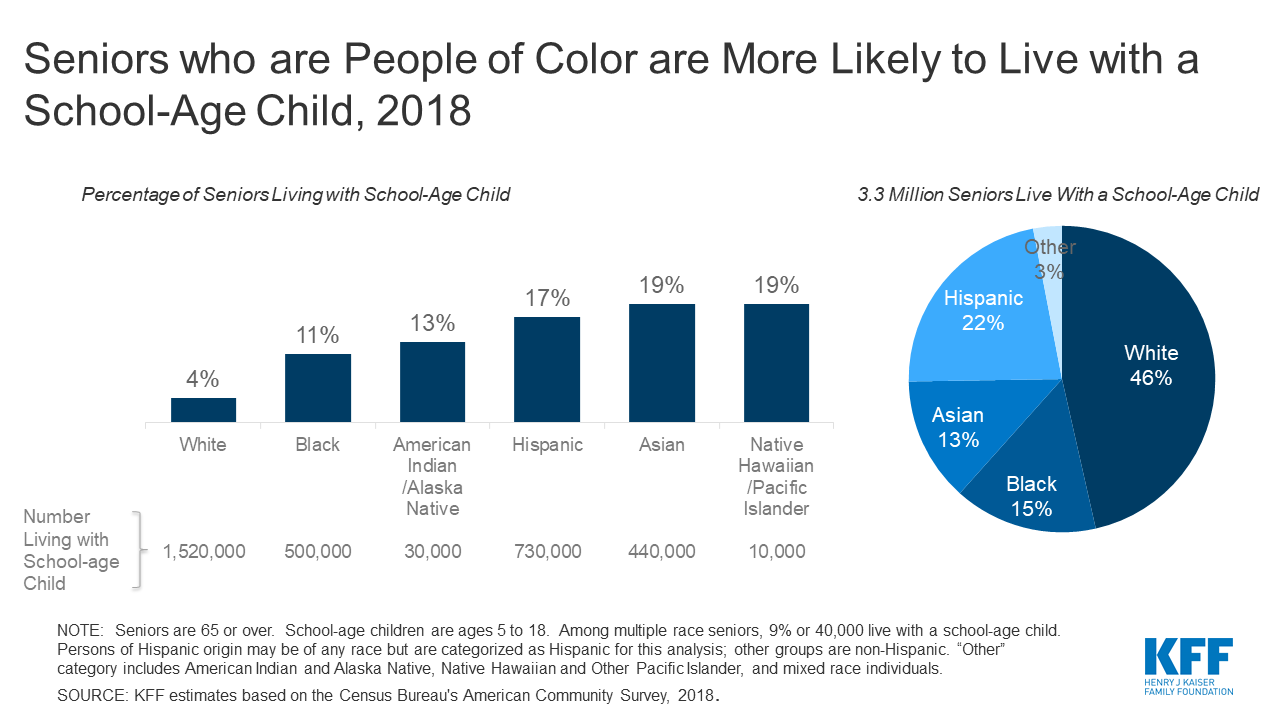
Nearly
one in five (19%) Asian and Native Hawaiian or Other Pacific Islander older
adults live with a school-age child, as do 17 percent of Hispanic older
adults, 13 percent of American Indian or Alaska Native older adults, and over
one in ten (11%) Black older adults. In contrast, four percent of older White
adults lives with a school-age child.
Even
as concerns about equity in education factor into decisions about reopening
schools, the potential spread of the virus from school children to older
adults could exacerbate the well-documented racial disparities in the broader
impacts of COVID-19, in which communities of color have accounted for a
disproportionate share of cases and deaths.
For
more KFF data and analyses concerning COVID-19, including a recent analysis about share of teachers at higher risk of
serious illness from the virus, visit kff.org.
Filling
the need for trusted information on national health issues, KFF (Kaiser Family Foundation)
is a nonprofit organization based in San Francisco, California.
|
|||
|
|||
|
Connect with us:
    |
|||
|
|||
Friday, July 17, 2020
Schools and COVID-19: 3.3 Million People Age 65 or Older Live with School-Age Children


Subscribe to:
Post Comments (Atom)
No comments:
Post a Comment