Dan
Goldbeck, Dan Bosch December 2, 2019
Last week only had four work days due to
Thanksgiving, but there was some activity on the regulatory front. Over the
course of the past week, two regulatory actions regarding health care issues
accounted for the vast majority of new costs. All other rulemakings with some
quantified economic impact brought a cumulative $16 million in total new costs.
Across all rulemakings, agencies published $2.2 billion in total net costs and
added 6.2 million hours of annual paperwork.
REGULATORY TOPLINES
·
New Proposed Rules: 41
·
New Final Rules: 70
·
2019 Total Pages: 65,790
·
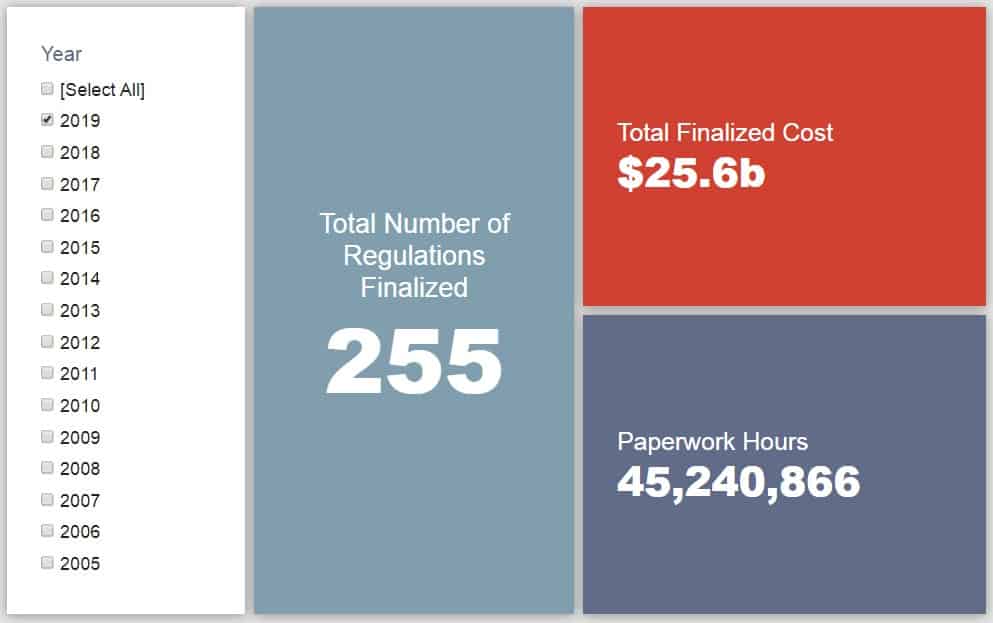
2019 Final Rule Costs:
$25.6 Billion
·
2019 Proposed Rule
Costs: $54 Billion
TRACKING THE REGULATORY BUDGET
The most notable rulemaking was the
administration’s latest proposal – promulgated jointly by the Department of
Health & Human Services (HHS), Internal Revenue Service, and Employee
Benefits Security Administration – regarding “Transparency in Coverage.” The proposed rule
would require insurance companies to disclose further information regarding a
variety of aspects of their customers’ cost-sharing burden. The agencies
estimate that this would yield nearly $129 million in annualized costs, or
roughly $1.8 billion in present value. Since it is still a proposed rule, these
costs do not yet accrue to the fiscal year (FY) 2020 regulatory budget under
Executive Order (EO) 13,771.
In terms of actions that do apply to the FY 2020
budget, HHS published a final rule regarding price transparency for hospitals. The
rule establishes “requirements for all hospitals … in the United States for
making hospital standard charges available to the public.” HHS estimates that
the administrative burden of these new requirements is roughly $23 million
annually, or $329 million in present value. As of this week, HHS has been one
of the more active agencies for EO 13,771 activity in FY 2020 with seven such
actions attributable to it either in part or in full. The Departments of
Transportation (DOT) and Agriculture also have seven actions to their credit.
For FY 2020, agencies have finalized 26
deregulatory actions and 10 regulatory actions, totaling $1.7 billion in
quantified total net costs. The Trump Administration has yet to release
its regulatory budget goal for FY 2020, though it is expected soon.
THIS WEEK’S REGULATORY PICTURE
This week, an agency-by-agency look at key regulatory
agenda data.
The week of Thanksgiving was a relatively
limited one in the pages of the Federal Register, so it’s worth taking a deeper
dive into the Fall 2019 Unified Agenda of Regulatory and Deregulatory
Actions, featured in this space last week.
While
we wait for final accounting from the Trump Administration to see how agencies
did relative to their FY 2019 regulatory budgets, the latest regulatory agenda
sheds some light on the pipeline of federal regulatory and deregulatory
activity.

The chart above shows the 10 agencies with the largest number of rulemakings under development. These agencies combine to make up 68 percent of all rulemakings listed in the regulatory agenda.
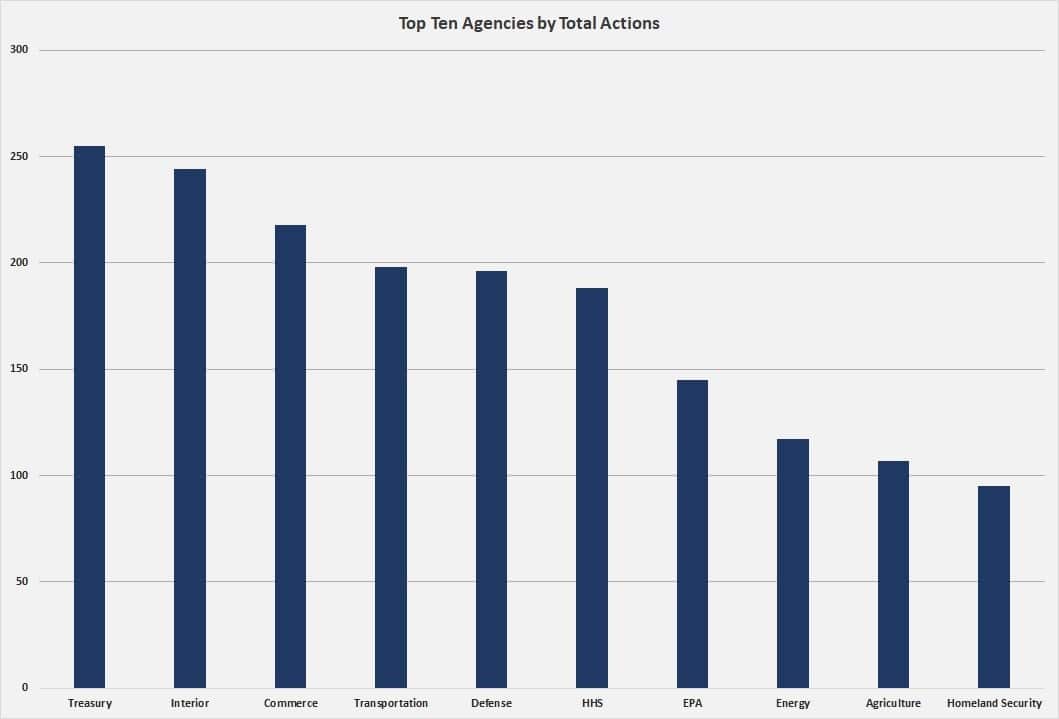
The chart above shows the 10 agencies with the largest number of rulemakings under development. These agencies combine to make up 68 percent of all rulemakings listed in the regulatory agenda.
When
these agencies are broken down into their expected regulatory and deregulatory
actions for purposes of EO 13,771, we find that the number of deregulatory
actions is not necessarily proportional to the number of total actions.

DOT has the most deregulatory actions despite having the fourth-most total actions. At 58 percent, its percentage of deregulatory actions is by far the largest of any agency listed here. The next closest are the Environmental Protection Agency (30 percent) and HHS (29 percent). The Department of the Treasury, which had the most total actions, has just a 16 percent deregulatory rate.
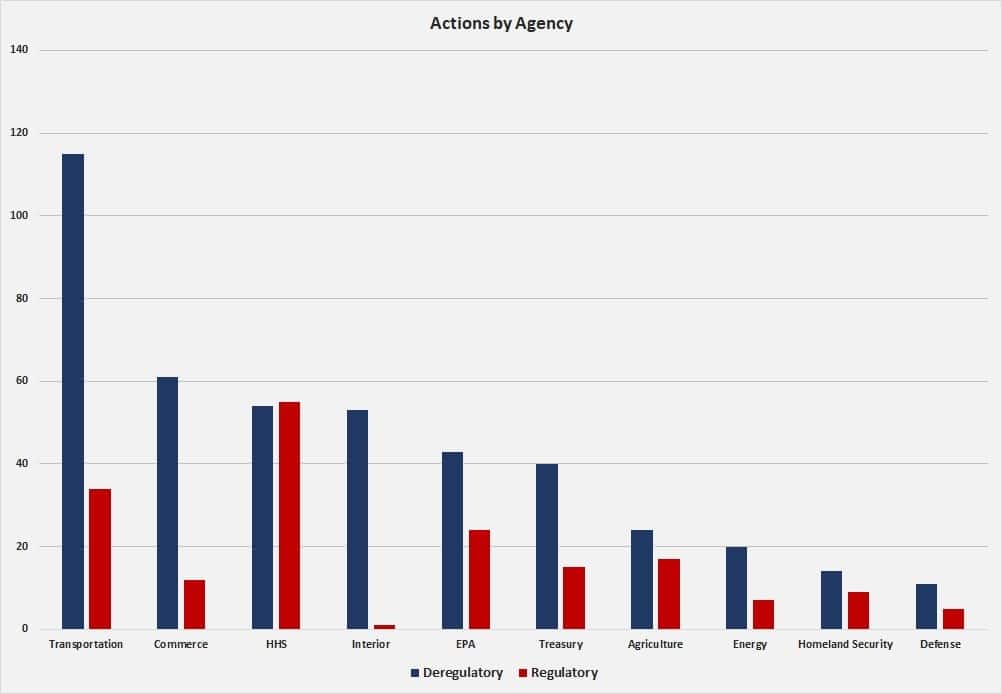
DOT has the most deregulatory actions despite having the fourth-most total actions. At 58 percent, its percentage of deregulatory actions is by far the largest of any agency listed here. The next closest are the Environmental Protection Agency (30 percent) and HHS (29 percent). The Department of the Treasury, which had the most total actions, has just a 16 percent deregulatory rate.
The main takeaway from the charts is while
having a lot of total actions in the regulatory agenda helps agencies have a
larger number of deregulatory actions, it is far from the determining factor.
TOTAL BURDENS
Since January 1, the federal government has
published $79.6 billion in total net costs (with $25.6 billion in finalized
costs) and 57 million hours of net annual paperwork burden increases (with 45.2
million coming from final rules). Click
here for the latest Reg Rodeo findings.
https://www.americanactionforum.org/week-in-regulation/a-pair-of-health-care-transparency-regulations-highlight-short-week/#ixzz67d7C6CD9
Follow @AAF on Twitter
Follow @AAF on Twitter

No comments:
Post a Comment