|
by Lance Robertson, Assistant Secretary for Aging and
Administrator, ACL
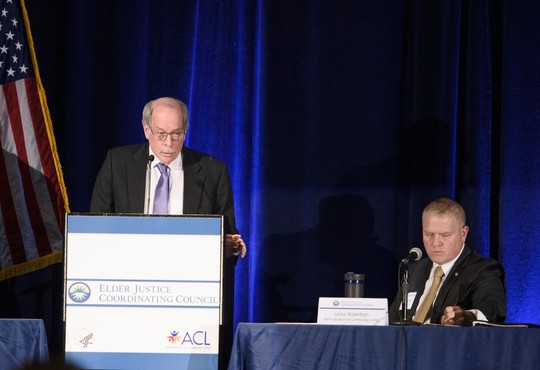
On Tuesday, I had the privilege of chairing the fall 2019
meeting of the Elder Justice Coordinating Council. The meeting
featured an impressive panel of experts offering insights from the field,
and the release of ACL's National Adult Maltreatment Reporting System
(NAMRS) data report for 2018. Leaders from across the federal government
also shared updates on their departments' efforts to combat elder abuse,
neglect, and exploitation.
I want to share four key themes that stood out throughout the
presentations and discussions. A central focus was the need to address
abuse across all residential settings, from communities–where most elders
reside–to congregate residential long-term care settings, like nursing
homes and assisted living. The importance of data, the criticality of
partnerships, and the need to engage the public were reinforced, as
well.
Addressing Abuse in
All Settings
Our meeting opened with a panel on elder abuse, neglect, and
exploitation across residential settings. Expert panelists described
unique dynamics and challenges of addressing abuse in each setting and
shared recommendations for the Council’s consideration.
Lori Smetanka, J.D., the Executive Director of the National
Consumer Voice for Quality Long-Term Care, shared heartbreaking stories of
abuse in long-term care facilities. She noted that this abuse can take many
forms and that the perpetrators could be either staff or other residents.
She also expressed concern that older adults experiencing abuse in
facilities often lack access to the victim services available to people living
in the community.
“As a society, it is incumbent upon us to intensify our
efforts to combat elder abuse and neglect at all levels and in all
settings, as well as support and seek justice for those who are
victimized,” Smetanka concluded.
Dr. Pamela B. Teaster, director of the Virginia Tech Center for
Gerontology, reinforced the need for evidence-based approaches.
“We must support people whose decision-making is compromised
so that they can exercise the greatest autonomy possible and enjoy a life
that is as full and healthy as possible,” Dr. Teaster told the audience.
“And we must do this morally and ethically, and grounded in a foundation
established by the best science and thinking possible.”
Elder Justice Coalition National Coordinator Robert Blancato
noted that although recent high profile cases of abuse in nursing homes
have captured media focus, the vast majority of abuse occurs in the
community, because that is where most older adults live.
“The average victim of elder abuse is an older woman living
alone between the ages of 75 and 80,” Blancato noted. Addressing isolation
and developing strong supports is critical to addressing elder abuse in the
community.
Data
The importance of data was a constant theme throughout the
meeting. As Elder Justice Coalition National Coordinator Robert Blancato
put it, “you can't stop what you don't know.”
That’s why ACL worked with Adult Protective Services (APS)
systems across the country to establish the first national system for
collecting data on the abuse, neglect, and exploitation of older adults and
adults with disabilities investigated and validated by APS programs. We are
now working with federal partners on an elder abuse predictive analytics
initiative, which will use advanced technology to find patterns in data
from NAMRS and other data sets that can inform future elder justice work.
The 2018 NAMRS
report represents the third year of NAMRS reporting.
One thing is clear – abuse is a growing problem. Between 2016 and 2018, APS
reported a 15% increase in investigations, and the number of substantiated
cases increased by nearly 6% (across the 44 states who reported these data
for each of the three years). This underscores the need for robust programs
to combat abuse, neglect, and exploitation as the population of older
adults and adults with disabilities continue to grow.
Although participation in NAMRS is voluntary, all 56 states
and territories have contributed data, and each year, they are increasing
their capacity to report more, and higher quality, information. This level
of participation is a testament to the dedication of APS programs to
informing critical elder justice efforts.
Partnerships
The meeting also drove home the importance of partnerships of
all types.
Our panelists highlighted the need for a coordinated,
multidisciplinary approach as critical to combating elder abuse. Smetanka
pointed to Georgia as one example. A partnership between Georgia’s
long-term care ombudsman, adult protective services, state and local law
enforcement and prosecutors, and other partners is working to stop benefits
trafficking of adults living in board and care homes. Blancato highlighted
the opportunity to build partnerships that bring emergency response
professionals to the elder justice table.
EJCC members also talked about partnerships in their work. For
example, the Social Security Administration is working with phone companies
to block fraudulent calls that are “masked” so they appear to be coming
from legitimate Social Security Administration numbers and the United
States Postal Inspection Service is working with Jamaican authorities to
stop lottery scams.
Public Engagement
Finally, the discussion highlighted ongoing engagement with
the public.
One memorable story came from Deborah Cox Roush of the
Corporation for National and Community Service, who shared how a volunteer
Senior Corp theater troupe used performances to start deeper conversations
about elder abuse. Similarly, the Consumer Financial Protection Bureau has
been expanding their popular collection of placemats with
information about common scams.
Successful public engagement also requires a lot of listening.
The EJCC declared 2019 a “year of listening” and has held 10 listening
sessions across the country to collect input that will shape our ongoing
work. (We also are collecting
public comments online until the end of the year.) We are
incredibly grateful for the valuable insights and wisdom that so many
people across the country have shared.
In conclusion, it is fitting that the EJCC met just a few days
after Thanksgiving, when we celebrate the intergenerational bonds of family
and friendship. These bonds are the reason that each of us has a
responsibility to act when an elder in our community is deprived of their
inherent dignity and rights. I am proud to work alongside champions like
our expert panelists and all of the partners who participated in this EJCC
meeting, and I know we will continue to make progress.
|


No comments:
Post a Comment