Tara
O'Neill Hayes July 8, 2019
Executive Summary
- Biologics and biosimilars are
some of the most expensive drugs due to high development costs and a
limited pool of potential users.
- Biosimilars are often thought
of as generic versions of biologic drugs, but federal policy is not
consistent in its treatment of biosimilars.
- In its inconsistent treatment
of biosimilars, federal policy appears to seek the greatest protection and
choice for Medicare beneficiaries as well as the greatest cost reductions
for the government and beneficiaries, though, sometimes that’s not always
clear.
Introduction
References to biosimilars are quickly becoming
more common in discussions of drug pricing. With more, and more expensive,
biologic products coming to market, patients and policymakers are eager for
generic-like versions to become available and provide a less expensive
alternative. But biosimilars, by definition, are not technically generics, and
the law does not always treat them like generics in terms of how they are
reimbursed and the regulations governing their coverage on a prescription drug
formulary. This paper provides some insight into those inconsistencies.
Background
The market for biologics has certain
constraints. Biologics are complex molecules made from living organisms, and as
a result, are much more expensive to develop and produce than small-molecule
drugs made from chemicals. Further, biologics often treat rare diseases and,
when they do, few patients use them (though, there are exceptions to this, with
a good example being Humira, which was originally approved as a mass-market
drug to treat rheumatoid arthritis (RA) and became the world’s best-selling
drug before it was given multiple orphan drug designations for treatment of
rare diseases).[1] This
combination of high expense and a small natural market means their price is
typically very high: In October 2016, MedPAC reported that biologics accounted
for less than 1 percent of prescriptions, but 28 percent of spending in
Medicare Part D.[2] All
of the top 10 Medicare Part B drugs in terms of total spending in 2017 were
biologic products and accounted for 46 percent of Part B drug expenditures
despite accounting for only 7.5 percent of all claims.[3] Between
2006 and 2015, the prices of Part B-covered biologics grew 38 percent, on
average, compared with a decline in prices of 18 percent for nonbiologics.[4] At
the same time, the prices of Part D-covered biologics grew 195 percent, while
the prices of all Part D-covered drugs grew just 67 percent.[5]
Insulin in 2014 made up the bulk of Medicare
Part D spending on biologics. (Insulin is in fact a biologic, even though it is
technically not currently classified as such; it will be on March 23, 2020.)
The next largest share of spending on biologics in Part D was on drugs to treat
inflammatory diseases, followed by drugs for Multiple Sclerosis.[6] In
Part B, the top 10 biologics are used to treat cancer, RA, Chron’s disease,
psoriasis, ulcerative colitis, and macular degeneration.
As of June 17, 2019, the Food and Drug
Administration (FDA) has approved 22 biosimilars, although only 10 have been
marketed in the United States and only 7 are commercially available, while more
than 40 have been approved for use in Europe.[7] The
limited selection might indicate that more options would lower prices, but even
if more biosimilars were on the market, it’s not clear that significant savings
would develop: It costs between $100-$250 million to develop a biosimilar
product, compared with $1-$4 million to develop a generic drug.[8] This
difference is largely because of the complexity of the approval process and the
difficulty in proving a drug’s similarity to the reference product.[9]
Coverage
Regarding Medicare Part D’s coverage
requirements, biosimilars are treated in a way that provides beneficiaries the
greatest choice and protection; or at least they will be once biosimilars enter
the Part D market.
In the context of Part D’s requirement for
insurers to cover at least two drugs per class, biosimilars are not considered
distinct from their reference product. Thus, covering only a reference biologic
and its biosimilar will not satisfy the “two drugs per class” rule.
When it comes to “transition fill coverage,”
however, the drugs are considered distinct. Rules require plans to offer
beneficiaries coverage of a one-time 30-day supply of a drug if the beneficiary
is already taking the drug and is losing coverage of that drug either because
they are switching plans or the insurer is changing its coverage in the next
calendar year.[10] An
insurer may stop covering a brand-name drug or may place coverage restrictions
on the drug (such as step therapy or prior authorization) if a generic version
becomes available in order to encourage patients to take the less expensive
medicine. The transitional fill coverage requirement is intended to help smooth
the transition for beneficiaries on an existing prescription regimen. This
requirement will not be satisfied by covering a biosimilar product if the
beneficiary is taking the reference product, since the two are considered
distinct in this context.
Similar to transition fill coverage, biosimilars
are considered distinct from the reference product in the context of mid-year
formulary changes. Insurers are allowed to stop coverage of a brand-name drug,
move a brand-name drug to a higher tier, or add coverage restrictions to a drug
if a generic drug becomes newly available; these are considered maintenance
changes and require approval from the Centers for Medicare and Medicaid
Services (CMS), but they are typically granted.[11] Dropping
a brand-name biologic in favor of a biosimilar, however, is considered a
non-maintenance change, since they are considered distinct drugs in this
context, and CMS is less likely to approve this change.
Reimbursement
Medicare Part B does not treat biosimilars like
either generics or brand-name drugs. For small molecule drugs in Part B, if a
generic drug exists, then the reimbursement for that drug is the same whether a
patient takes the brand-name or generic version. The reimbursement amount is
based on the volume-weighted average sales price (ASP) of both the brand-name
and generic versions of the drug, which reduces the reimbursement rate
(relative to what it would be if based solely on the price of the brand-name
drug) and therefore encourages use of the cheaper generic version. For
single-source drugs and biologics, the reimbursement rate is 106 percent of the
ASP of the drug. For biosimilars, a blended reimbursement formula is used,
though the precise formula was changed through regulation, effective January 1,
2018. Originally, all biosimilars of a given reference product were reimbursed
equally, with the base payment amount based on the ASP of all the biosimilars,
but the add-on payment equal to the add-on payment for the reference product,
as explained here. This provided a reimbursement amount that
was less than that provided for the innovator drug (saving money for Medicare)
while not disincentivizing providers from using the lower-cost drug (because
the add-on payment was the same as that for the higher-priced drug).
Critics complained, however, that biosimilars should
not be reimbursed this way since one biosimilar may treat different or fewer
indications than another biosimilar of the same product. In response to this
criticism, CMS issued a new regulation in November 2017 that would provide a
separate billing code and reimbursement amount for each biosimilar using each
individual drug’s own ASP for the base payment amount and maintaining the use
of the reference biologic’s ASP for the add-on payment.[12] This
new reimbursement policy may lead to higher spending, though—at least
initially, as the change reduces price competition among similar products. It
is hoped, however, that the more favorable reimbursement will encourage more
biosimilar market entrants, ultimately saving money by shifting market share
away from the more expensive innovator products.
In Part D, until the Balanced Budget Act (BBA)
of 2018, biosimilars were treated as generics in the coverage gap discount
program (CGDP), meaning they were not required to pay the mandatory rebate that
brand-name manufacturers were required to pay. With brand name drugs, the
manufacturer’s discount is applied toward the beneficiary’s calculated
out-of-pocket cost (known as true out-of-pocket (TrOOP) cost), as though the
beneficiary paid the amount covered by the discount, accelerating the
beneficiary through the coverage gap. For generics, in contrast, beneficiaries
faced higher coinsurance rates for such drugs and also did not benefit from
accelerated TrOOP calculations. The BBA changed this policy, and now
biosimilars must pay coverage gap rebates. This change may not hurt biosimilars
however, since the previous rules made biosimilars less favorable to insurers
from an insurer liability perspective: During the gradual transition to
close the coverage gap, insurers were required to cover a greater share of the
cost of generics and biosimilars than they were for brand-name drugs, as
shown here.
Despite the BBA’s changes in February 2018
regarding the coverage gap discount, in April 2018 CMS finalized a rule to
treat biosimilars as generics when it comes to determining the cost-sharing
amount for beneficiaries eligible for the low-income subsidy (LIS).[13] LIS
beneficiaries are only required to pay between $1.25 and $3.40 for generic and
biosimilar drugs and $3.80 and $8.50 for brand-name drugs.[14]
In Medicaid, biosimilars are treated as
single-source brand-name drugs for purposes of determining their minimum
required rebate amount under the Medicaid Drug Rebate Program.
The following chart summarizes how biosimilars
are characterized for purposes of reimbursement under the various federal
health insurance programs:
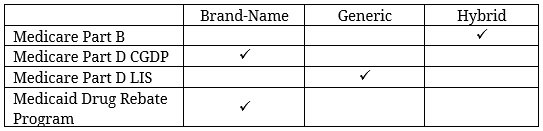
The differences in reimbursement policy in
Medicare Parts B and D and Medicaid all seem aimed at reducing costs for
patients and the government—whether by requiring the biosimilar manufacturers
to pay larger rebates or providing patients and providers financial incentives
to use biosimilars relative to brand-name products.
Conclusion
While biosimilars are sometimes treated like
single-source, brand-name drugs and sometimes treated like generics, the one
consistency seems to be that each decision is designed to increase choice and
reduce costs. In terms of coverage, policies are aimed at giving patients the
greatest amount of choice and protecting their access to medications. In terms
of reimbursement, policies aim to reduce the government’s and patients’ costs,
either directly through greater rebate requirements or indirectly by
encouraging development and utilization of biosimilars over the brand-name
reference product. Yet just as the biosimilar market is evolving, these policies
could as well, and they are worth watching.
[2] http://www.medpac.gov/docs/default-source/default-document-library/biosimilarsinmedicarepartd_oct16_pres_sec.pdf?sfvrsn=0
[3] https://www.cms.gov/Research-Statistics-Data-and-Systems/Statistics-Trends-and-Reports/Information-on-Prescription-Drugs/MedicarePartB.html
[4] http://www.medpac.gov/docs/default-source/data-book/jun18_databooksec10_sec.pdf?sfvrsn=0 (pg.
153, 182)
[5] http://www.medpac.gov/docs/default-source/data-book/jun18_databooksec10_sec.pdf?sfvrsn=0 (pg
181, 182)
[6] http://www.medpac.gov/docs/default-source/default-document-library/biosimilarsinmedicarepartd_oct16_pres_sec.pdf?sfvrsn=0
[7] https://biosimilarsrr.com/us-biosimilar-filings/, https://www.ncbi.nlm.nih.gov/pmc/articles/PMC6355057/, https://www.biosimilarscouncil.org/wp-content/uploads/2019/06/Biosimilars-Council-White-Paper-Failure-to-Launch-June-2019.pdf
[10] https://www.medicareinteractive.org/get-answers/medicare-prescription-drug-coverage-part-d/medicare-part-d-coverage/transition-drug-refills
[11] https://www.cms.gov/Medicare/Prescription-Drug-Coverage/PrescriptionDrugCovContra/Downloads/Part-D-Benefits-Manual-Chapter-6.pdf
[12] https://www.federalregister.gov/documents/2017/11/15/2017-23953/medicare-program-revisions-to-payment-policies-under-the-physician-fee-schedule-and-other-revisions
[13] https://www.centerforbiosimilars.com/contributor/brian-lehman/2018/04/cms-finalizes-policy-to-lower-the-cost-of-biosimilars
https://www.americanactionforum.org/insight/the-inconsistent-treatment-of-biosimilars-in-medicare-and-medicaid/#ixzz5tHYPPa4H
Follow @AAF on Twitter

No comments:
Post a Comment