Christopher
Holt October 5, 2018
It can sometimes feel like every new public
policy endeavor ends up tangled in unintended negative consequences. Reporters
and analysts have fallen over themselves detailing how well-intentioned policy
making has caused innumerable problems. Just two weeks ago the
Weekly Checkup considered how Medicaid “best price” tripped up charity care,
resulting in the creation of the 340B program, which itself had become ensnared
in myriad policy problems. It might be encouraging, then, to turn to examples
of public policy that have turned out well.
Two examples of highly successful legislative
initiatives are the Medicare Advantage (MA) and Medicare Part D programs. These
efforts leverage private market competition to provide America’s seniors with
better care and better value, and they have been extraordinarily successful for
years.
The MA program is noteworthy this week, as the
Centers for Medicare and Medicaid Services (CMS) recently announced details
about the 2019 plan year.
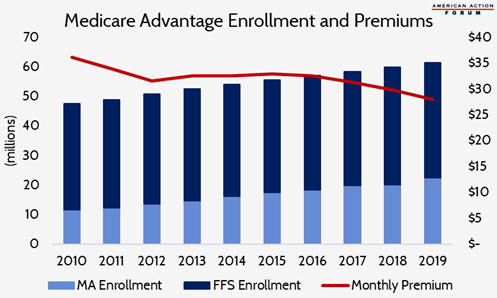
Next year, MA enrollees will see an average monthly premium of $28, down about
6 percent from this year. That drop shouldn’t surprise you—MA premiums have
been trending slightly downward for a couple of years—but it might because
observers seem constantly to underestimate the power of competition to control
costs. CMS also reports that the number of insurance plans offered through MA
will increase by roughly 600. Over 91 percent of Medicare beneficiaries will
have 10 or more MA plans to choose from if they elect to enroll in the
program—up from 86 percent this year.
Even more important, plan sponsors will have new
flexibility to offer beneficiaries a broader range of services thanks to
rulemaking earlier this year by the Trump Administration. Prior to the 2019
plan year, federal law limited insurers’ freedom to offer unique benefits
tailored to the specific needs of beneficiaries. These “uniformity rules” meant
that each individual enrolled in a plan had to be given the same benefits at
the same cost. Starting in 2019, plans will be able to alter benefits and
cost-sharing within a plan to encourage use of the most appropriate services
for individuals based on their specific medical conditions. For example,
diabetic patients may be offered reduced cost-sharing for visits to the
endocrinologist and coverage of additional foot exams. You can read more about
the administration’s Medicare rulemaking in this piece by
AAF’s Tara O’Neill Hayes.
It shouldn’t be surprising that competition
works, or that the programs that are most successful and popular with
beneficiaries are the ones that seek to leverage that competition. Nor should
it be surprising that enrollment in MA continues to grow (projected to increase
by 11.5 percent over 2018) as the administration provides plan sponsors with
even more flexibility to meet the needs of their beneficiaries and to compete
for new enrollees.
CHART REVIEW
Tara O’Neill
Hayes, Deputy Director of Health Care Policy
The Medicare Advantage program continues to
enroll a growing share of Medicare beneficiaries. In 2019, it is estimated that
nearly 37 percent of beneficiaries will choose to enroll in a privately managed
Medicare plan, up from less than 25 percent in 2010. This increase is not
surprising, given that premiums have remained relatively flat for years and in
2019 will decline for the fourth straight year. Further, 91 percent of seniors
will have 10 or more MA plans from which to choose.
https://www.americanactionforum.org/weekly-checkup/the-continuing-success-of-medicare-advantage/#ixzz5TXKhzLnY
Follow: @AAF on Twitter

No comments:
Post a Comment