|
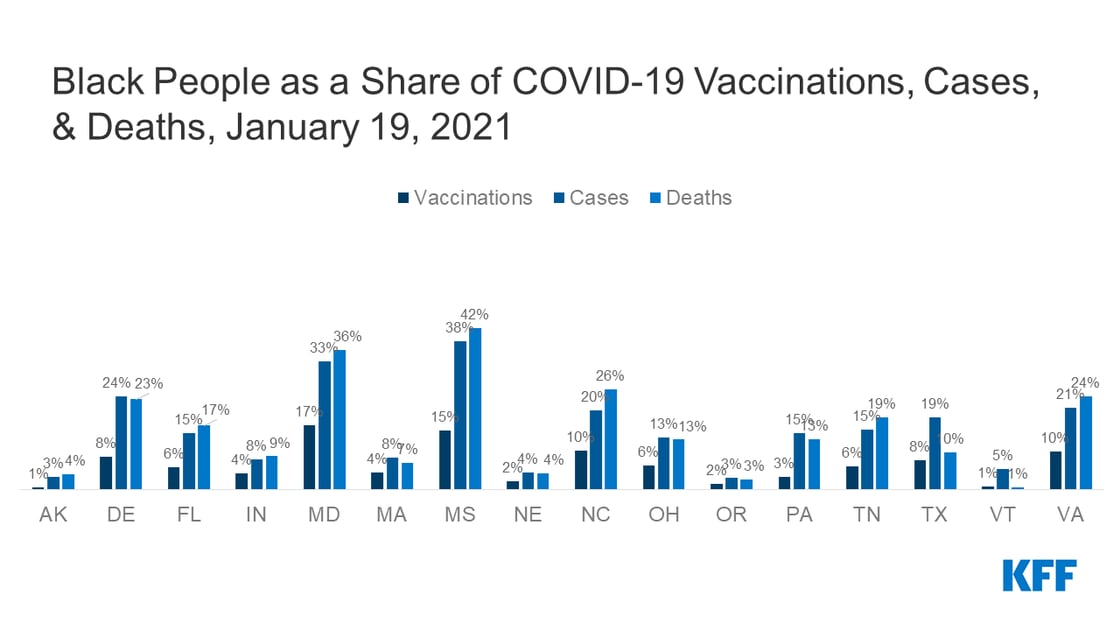
White Americans’ share
of vaccinations is larger than their share of cases in 13 of the 16
reporting states and larger than their share of deaths in 9 states.
Asian Americans are
experiencing fewer and smaller gaps between their share of vaccinations
and cases in reporting states. Data on Asians’ share of deaths is limited
and data gaps also exist for American Indian and Alaska Native and Native
Hawaiian and Other Pacific Islander people.
Vaccines are not yet
broadly available and states are prioritizing specific groups before the
general public, so vaccination patterns may change as more data is
available. However, data and our news
reporting at KHN have shown that vaccination is lagging by
various measures for people of color. KFF will regularly update the data
by race/ethnicity to track racial disparities in access and
administration of COVID-19 vaccines.
Also available is a new data note
examining the makeup (by race/ethnicity, income level, age, gender,
education, and citizenship status) and health insurance coverage status
of the estimated 15.5 million health care workers with direct patient
contact. Health and long-term care workers were among the first
groups prioritized for the COVID-19 vaccination based on federal
guidelines, which states have tailored and implemented.
Some key findings in the
data note include:
- Overall,
59% of health care workers are White and 41% are people of color
(including 17% who are Black, 14% who are Hispanic, and 8% who are
Asian). However, the majority (52%) of workers in long-term care
settings are people of color (including 28% who are Black, 15% who
are Hispanic, and 6% who are Asian) while 48% are White.
- A
large majority (77%) of health care workers are women, and the
number rises to 84% in long-term care settings.
- 17%
of health care workers are low-income (household income less than
200% of the federal poverty level), with 5% having household income
below the poverty level. One-third (33%) of workers in long-term
care settings are low-income, including 11% who have household
income below poverty.
- 14%
of health workers in long-term care are uninsured and about one in
five (21%) have Medicaid coverage. Overall, less than one in ten
(7%) health care workers are uninsured.
- Eight
in ten of health care workers have completed at least some college,
while 4% have not completed high school. Among those working in
long-term care, six in ten have completed some college, with 10%
having less than a high school education.
Media reports indicate
some health workers are opting not to be vaccinated, particularly among
those working in long-term care facilities, and recent KFF COVID-19 Vaccine Monitor data show that roughly three in ten health care workers
(29%) express hesitancy about getting a COVID-19 vaccine. A better
understanding of the health care workforce in direct contact with
patients can better inform educational efforts and messages about the
vaccine to ensure equity in its distribution. Read Key Characteristics of Health Care Workers and
Implications for COVID-19 Vaccination for the full
findings and discussion.
|
.png?width=1200&upscale=true&name=Just%20Released%20Header_1%20(1).png)


No comments:
Post a Comment